Lighthouse now measures agentic browsing — what Google is checking, and why our AI-Ready stacks already score green without further implementation
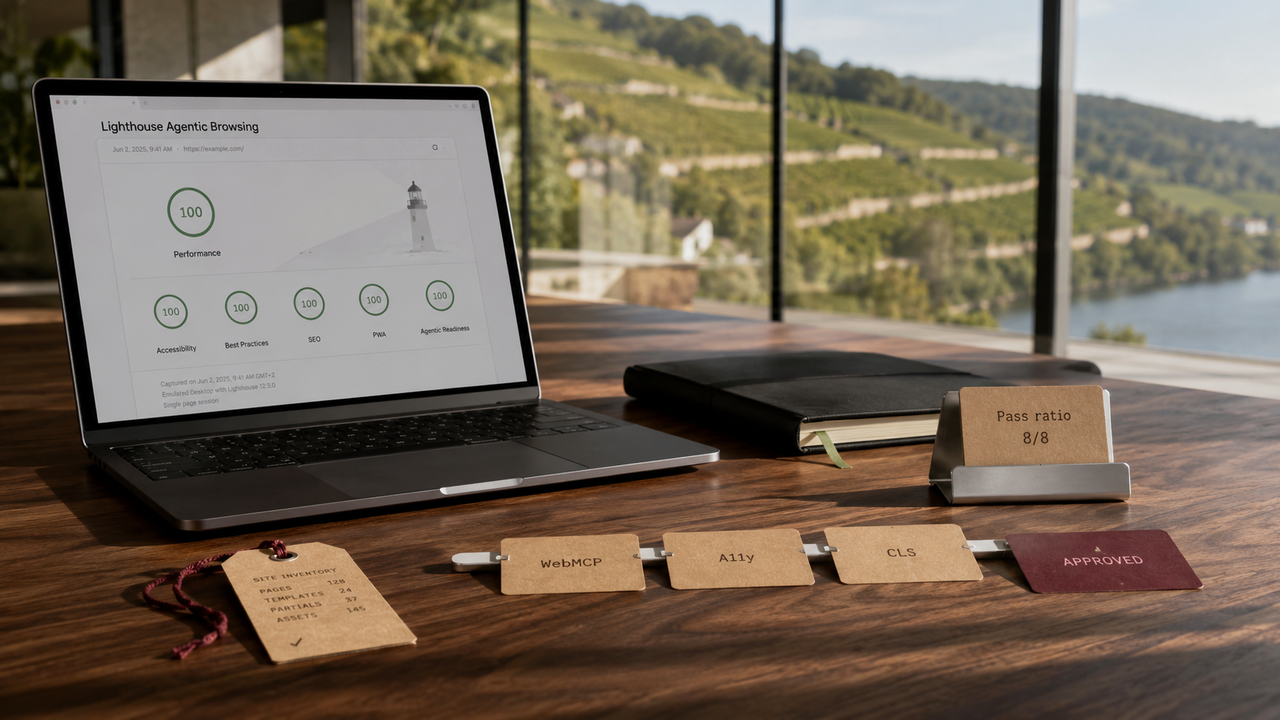
20 May 2026. Google has extended Lighthouse with a new experimental category: Agentic Browsing. Four areas are scored — WebMCP integration, discoverability via llms.txt, accessibility-tree quality from an agent perspective, and layout stability. Instead of a 0-to-100 score, there is a pass fraction plus pass/fail per audit. Anyone running a TYPO3 or Sylius platform on our AI-Ready architecture meets the mandatory audits without additional implementation — because the WebMCP server, the clean accessibility tree and the CLS discipline are components of the four layers that we have been shipping as a stack for two years. This post walks through the Lighthouse category in detail and which of our building blocks covers which audit.
TL;DR — the 90-second summary
- What is new?
Lighthouse has gained an experimental category Agentic Browsing — four topic areas: WebMCP integration, discoverability, accessibility tree, layout stability.
- How is it scored?
No 0-to-100 score — instead a pass ratio plus pass/fail status per audit.
- Am I covered as a Moselwal customer?
Yes, for the most part.
moselwal/webmcpdelivers the WebMCP tools, the A11y discipline is part of our editor/template convention, CLS is controlled through the site-package templates, andllms.txtis active on every platform.
What Lighthouse now measures
Google has positioned Lighthouse as the de-facto quality gate for web delivery since Performance, Accessibility, Best Practices, SEO and the PWA era. With the new category Agentic Browsing — currently flagged experimental — another axis is added that targets a very specific question: How well can an AI agent understand this page and interact with it?
The category is not just documentary. Lighthouse typically runs as part of CI/CD pipelines, so Agentic Browsing will become a measurable requirement on front-end teams over the coming months — comparable to what Core Web Vitals have been since 2020. Whoever has structurally built for agents today sees a green score tomorrow without the build system going red.
The five audit areas in detail
1. Registered WebMCP tools
Lighthouse talks to the page over the Chrome DevTools Protocol (CDP) WebMCP domain and observes which tools are registered. Both declarative tools (marked up in the HTML via special tags) and imperative tools (registered in JavaScript via navigator.modelContext.registerTool()) are scored.
2. Forms without declarative WebMCP
Forms that are not declared through WebMCP are a black box for agents — the agent has to guess what the input fields mean and which validations apply. The audit finds forms without WebMCP annotation and flags them.
3. WebMCP schema validity
If a tool declares an input schema (a JSON-Schema-like structure with types and required fields), Lighthouse checks whether the schema is syntactically and semantically valid. Invalid schemas produce audit failures.
4. llms.txt as a discoverability signal
Lighthouse checks whether the domain root carries an llms.txt — a machine-readable summary of the site that LLMs can use as an entry document. Important note: Google’s own AI Optimization Guide from May 2026 states that llms.txt is not mandatory for SERP visibility — Lighthouse measures it anyway, because it remains useful for agent discovery.
5. Accessibility audits from an agent perspective
Agents use the accessibility tree as their primary data model. Lighthouse picks a subset that is particularly relevant for machines:
- Names and labels — every interactive element needs a programmatic name.
- Tree integrity — roles and parent/child relationships must be valid.
- Visibility — no content is hidden in the A11y tree while interactive.
Plus cumulative layout shift (CLS) as a stability metric.
Why there is no 0-to-100 score
Google says so explicitly in the documentation: because the standards for the agentic web are still emerging, the goal is to collect data and deliver pass/fail signals first, instead of cementing a ranking. That is methodologically sound — a 0-to-100 scale that gets refined later would make the score historically unstable.
In practice that means: you get a pass ratio in the category header (e.g. „6 out of 8 audits passed“) plus pass/fail/warning per audit. CI/CD integration is possible (pipeline break on critical failures), but the evaluation has to be a little richer than a simple score threshold.
What our AI-Ready stacks already cover — audit by audit
Here is the direct mapping per audit area:
| Lighthouse audit | What we deliver | Source in the stack |
|---|---|---|
| Registered WebMCP tools | Declarative WebMCP tools for search, navigation, page-content (TYPO3) plus product-search and product-detail (Sylius). Tools are registered server-side via a site set, so there is no timing risk. | moselwal/webmcp (open source) plus site-package-specific tool providers |
| Forms without declarative WebMCP | All standard forms (contact, Sylius checkout, filter forms) are WebMCP-annotated. Custom forms in the backend pick up the annotation via a template-inheritance pattern. | Site-package templates plus the moselwal/webmcp form helper |
| WebMCP schema validity | Tool definitions are generated server-side and validated against a JSON Schema before they are delivered to the browser as declarative markup. Invalid schemas break the build, not the browser. | moselwal/webmcp tool registry with schema-validation hook |
| llms.txt | Generated automatically from the Schema.org stack plus a site-specific description. Updated on every publish. | moselwal/semantic-delivery (channel layer) |
| A11y: names and labels | Editor convention plus template hardening (every form field has aria-label, every button has aria-labelledby or text content). | Site-package templates plus editorial guide |
| A11y: tree integrity | Semantic-HTML-first policy in our templates: no <div> soup but <article>, <section>, <nav>. ARIA is used only to complement, not replace. | Site-package templates plus content-block spec |
| A11y: visibility | Show/hide logic uses the hidden attribute or display:none, not aria-hidden plus visibility:hidden combinations. | Front-end template convention |
| CLS | Hero images ship with width/height attributes, web fonts ship with font-display: optional, no ads at all. | Site-package templates plus the moselwal/structured-content image pipeline |
Concretely: anyone running a TYPO3 site on our AI-Ready platform should see all mandatory audits green on the first Lighthouse run with the new category. The pass ratio should be 8/8, with occasional warnings for edge cases.
AI-Ready Commerce (Sylius) — same setup, one additional tool
For shop sites, the tool family for product search and product detail comes on top. It is part of our Sylius site-package extension and follows the same declarative pattern as the TYPO3 tools.
If you are not with us — minimum implementation per audit
The audits are not exclusive to our platform — any CMS or e-commerce system can satisfy them if the discipline is there. Per audit area, the minimum implementation:
WebMCP tools: The simplest path is declarative WebMCP markup in the HTML — no JavaScript complexity, no timing issues. Three tools are a good start: search, navigation, page-content. Shops add product-search.
Form annotation: Each form gets a name property on every input element plus a WebMCP tool annotation that declares the form as an invocable action.
Schema validation: Define a JSON Schema per tool, run it against a validator before deploy. A CI pipeline step.
llms.txt: A static Markdown document at the web root that summarises the site structure and the most important content. Generation can be manual or a build step from page metadata.
Accessibility: Semantic HTML instead of <div> soup. Every interactive element gets a programmatic name. ARIA only as supplement. CLS below 0.1.
If you have a TYPO3 or Sylius estate and want to set this up yourself: our open-source package moselwal/webmcp is built precisely for this and is MIT-licensed. The tool registry, the schema validation and the CDP hook are included out of the box.
Frequently asked questions on the Lighthouse Agentic Browsing category
What happens if CLS is poor on a single page?+
Lighthouse rates the audit as fail (or warning); the pass ratio drops accordingly. Operationally, the most common CLS triggers are images without width/height, web fonts without font-display: optional, and ad slots that get sized only after the first render. All three have well-known fixes — we apply them in every site-package deployment.
How bad is it if forms get flagged for missing WebMCP annotation?+
Quite noticeable — forms are the lever with which an agent executes an action (place an order, sign up, filter). Without WebMCP, the agent guesses what the fields mean and often trips over validations. Take the audit flag seriously, retrofit the forms.
Is an llms.txt enough to pass the audit?+
For that one audit, yes — Lighthouse simply checks for the existence of llms.txt. It does not evaluate content quality. You should still generate it cleanly (site structure, key content clusters, contact), because it is read by actual LLMs as an entry document.
Do I need WebMCP if I’m not targeting AI agents?+
Structurally yes, because the trend points toward agent consumption (Claude in Chrome, ChatGPT search, copilots-in-browsers). Whoever bets on a pure crawler model today will lose reach tomorrow. Plus: the A11y discipline WebMCP requires is a direct win for screen-reader users as well.
Is the category stable yet?+
It is flagged „experimental“. That means: audit definitions can change in coming versions, pass criteria can be sharpened. Even so, getting started now is worthwhile — the structural requirements (WebMCP, A11y, CLS, llms.txt) are stable; the detail thresholds may shift, but not the direction.
Bottom line
Lighthouse Agentic Browsing is the next axis along which CMS and commerce platforms get measured. The category is experimental, but the five audit areas (WebMCP tools, form annotation, schema validity, llms.txt, A11y plus CLS) are structurally stable and won’t drift in other directions.
Anyone running on our AI-Ready CMS or AI-Ready Commerce platform sits largely green on the audits without further implementation — because the layers Lighthouse measures are the mandatory building blocks of our stack. Whoever wants to retrofit it themselves has the right toolbox in moselwal/webmcp (open source, MIT) plus semantic-HTML discipline. Both paths lead to the same outcome: a Lighthouse pass rate that doesn’t need to be patched together in a maintenance sprint, but is a by-product of a clean architecture.
Evaluate the AI-Ready platform with us?
If you operate a TYPO3 or Sylius platform and want to know where you stand today in the Lighthouse Agentic Browsing category — or whether our AI-Ready CMS or AI-Ready Commerce platform fits your setup — talk to us. We do the first audit run together, walk you through the concrete pass/fail markers, and suggest the shortest migration path.
Or email us directly: kontakt@moselwal.de
Related posts
![[Translate to English:] Walnuss-Schreibtisch mit antiquem Setzkasten (vier Fächer voller Bleilettern), geöffneter Brass-Karteikassette mit Kraftpaper-Tags, messingfarbener Lupe und einem aufrecht gestellten Oxblood-Wachssiegel-Etikett; im Hintergrund die Glasfront eines modernen Moselhauses mit sonnigem Weinberg-Hang — visuelle Metapher für die vier Schichten eines AI-ready CMS: strukturierte Inhalte, semantische Auslieferung, Agent-Interaktion und Vertrauen.](/fileadmin/_processed_/a/3/csm_67118060b63fe73c743485051efa3328caa4e62b8a211e2addb1b9a3c5fe9bfb_e288f8d4b8.jpg)
What makes a CMS AI-ready? — four layers that turn a TYPO3 backend into a retrieval-capable platform
Weiterlesen →
Google says: no llms.txt needed — and why that is only half the truth for an AI-ready CMS
Weiterlesen →
AI-ready platform: four layers
Weiterlesen →![[Translate to English:] 100 von 100 Punkten im AI Agent Test](/fileadmin/_processed_/9/d/csm_Bildschirmfoto_2026-04-19_um_20.21.47_e163b946bc.png)
Level 5 Agent-Native: 100/100 on Cloudflare's Check
Weiterlesen →